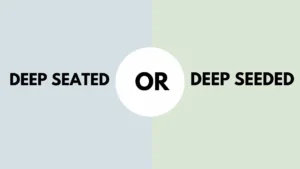
Many English learners and even native speakers often confuse “deep seated” with “deep seeded.” These two phrases sound almost identical, but standard English accepts only one of them as correct. Because they are so similar, people often use the wrong version without realizing their mistake.
This confusion is very common online. People frequently search for “deep seated or deep seeded” to find out which one they should use in writing, emails, or everyday conversation. Using the wrong phrase can sometimes make your writing look less polished or less professional.
Understanding the correct usage is important, especially if you want to improve your grammar and communication skills. In this article, you will learn the meaning of both phrases, their differences, examples, common mistakes, and simple tips to remember the correct one easily.
Quick Answer
We use the phrase “deep seated” as the correct form.The term describes something firmly established or strongly rooted in feelings, beliefs, or systems.
Many people make the mistake of using “deep seeded,” but standard English generally considers it incorrect.
Meaning and Definition of Each Word
1. Deep Seated
Definition:
“‘Deep seated’ describes something firmly established, strongly rooted, or difficult to change.”
Explanation:
“The idea of something being firmly placed or settled forms the word ‘seated.’ So, ‘deep seated’ describes emotions, beliefs, or problems that are deeply fixed.”
Examples:
- She has a deep seated fear of heights.
- “People in their culture hold a deep seated belief in fairness.”
- His anger comes from a deep seated issue in his past.
2. Deep Seeded
Definition:
“Formal English does not consider ‘deep seeded’ correct.”
Explanation:
Many people think it comes from the word “seed,” meaning something planted and growing. While this idea makes sense logically, it is not the accepted phrase in English.
Examples (Incorrect Usage):
- He has a deep seeded fear of failure.
- The system has deep-seated corruption.
Corrected Versions:
- ✅ He has a deep seated fear of failure.
- ✅ There is deep seated corruption in the system.
Key Differences Between the Words
Here are the main differences between deep seated and deep seeded:
- Correctness:
- “Deep seated” is correct.
- “Deep seeded” is incorrect.
- Origin:
- “Deep seated” comes from the idea of something being firmly “seated” or settled.
- “Deep seeded” is a mistaken version influenced by the word “seed.”
- Usage:
- “Deep seated” is used in formal and informal writing.
- “Deep seeded” should be avoided.
- Meaning:
- “Deep seated” means deeply rooted or strongly established.
- “Deep seeded” has no official meaning in standard English.
Comparison Table
| Word | Meaning | Usage | Example Sentence |
| Deep Seated | Firmly established or rooted | Correct usage | She has a deep seated fear of spiders. |
| Deep Seeded | Not standard English | Incorrect usage | ❌ He has a deep seeded fear of failure. |
Examples in Sentences
Using “Deep Seated” (Correct)
- His deep seated anger affected his relationships.
- She struggles with deep seated insecurities.
- The country faces deep seated economic problems.
Incorrect Usage of “Deep Seeded”
- ❌ He has a deep seeded hatred for injustice.
- ❌ Her deep seeded fears stopped her from trying.
Corrected Versions
- ✅ He has a deep seated hatred for injustice.
- ✅ Her deep seated fears stopped her from trying.
Common Mistakes
Here are the most common mistakes people make:
1. Using “Deep Seeded” Instead of “Deep Seated”
Incorrect:
- ❌ Deep seeded problems
- ❌ Deep seeded fear
Correct:
- ✅ Deep seated problems
- ✅ Deep seated fear
2. Assuming “Seeded” Makes Logical Sense
Many people think “seeded” is correct because seeds grow roots. While this idea is logical, English does not use this phrase.
3. Mixing Up Spoken and Written English
In speech, both phrases sound similar. This causes confusion when writing.
Tips to Remember the Difference
Here are some simple tricks to help you remember:
1. Think of “Seated” as “Sitting Firmly”
If something is seated, it is firmly in place just like a person sitting in a chair.
👉 “Deep seated” = firmly fixed
2. Avoid “Seeded” Completely
If you see “deep seeded,” replace it with “deep seated.”
3. Use the Word “Set”
“Seated” is similar to “set” or “settled.”
👉 Deep seated = deeply settled
4. Practice with Examples
Repeat sentences like:
- “She has a deep seated fear.”
- “This is a deep seated issue.”
When to Use Each Word
Use “Deep Seated” When:
- Talking about emotions
- Deep seated fear
- Deep seated anger
- Talking about beliefs
- Deep seated values
- Deep seated traditions
- Talking about problems
- Deep seated issues
- Deep seated corruption
Avoid “Deep Seeded” In All Cases
Even though it is commonly used informally, it is not correct in standard English writing.
Grammar Rules (If Applicable)
While “deep seated” is more of a fixed expression (idiom), here are some grammar points:
- It is usually used as an adjective phrase.
- It comes before a noun.
Structure:
- Deep seated + noun
Examples:
- Deep seated fear
- Deep seated problem
- Deep seated belief
Synonyms or Related Words
You can also use these words instead of “deep seated”:
- Deep-rooted
- Strongly established
- Firmly fixed
- Ingrained
- Embedded
Examples:
- Deep-rooted fear
- Ingrained habits
- Firmly established beliefs
Frequently Asked Questions (FAQs)
1. Is “deep seeded” ever correct?
No, “deep seeded” is not correct in standard English. Always use “deep seated.”
2. Why do people say “deep seeded”?
People confuse it with the word “seed,” thinking it means something that grows deeply. It sounds logical but is incorrect.
3. What does “deep seated” mean?
It means something that is firmly established, deeply rooted, or hard to change.
4. Can I use “deep rooted” instead?
Yes, “deep-rooted” is a correct alternative and has a similar meaning.
5. How can I remember the correct phrase?
Remember: “seated = settled.”
So, “deep seated” means deeply settled or fixed.
Conclusion
The confusion between deep seated or deep seeded is very common, but the correct phrase is “deep seated.” It describes something that is firmly established or deeply rooted, such as emotions, beliefs, or problems.
By remembering simple tips like “seated means settled,” you can easily use the correct phrase every time.Improving small grammar details like this can make your communication clearer, more professional, and more confident.