Many English learners and even native speakers often get confused between all right and alright. Both words sound the same and are used to express agreement, approval, or that something is correct. However, there is a subtle difference in their acceptance and usage, especially in formal writing.
People frequently search for “[all right or alright]” because they want to know which spelling is correct, particularly when writing essays, emails, or professional documents. Misusing them can make your writing look informal or careless.
Understanding the difference between all right and alright is essential for clear and professional communication. In this article, you will learn the definitions, correct usage, common mistakes, and easy tips to remember which one to use.
Quick Answer
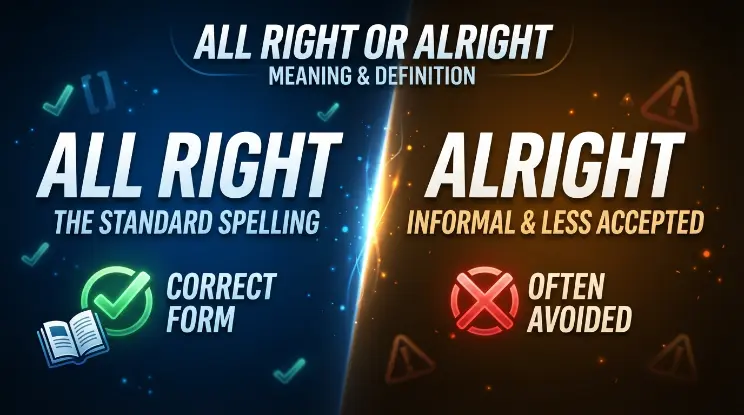
The difference between all right and alright is simple: “all right” is the standard, grammatically correct form used in both formal and informal writing, while “alright” is considered informal or nonstandard. Use all right in formal writing to ensure correctness, and alright mainly appears in casual texts or dialogue.
Meaning and Definition of Each Word
All Right
- Definition: “All right” is the correct, standard form used to mean that something is correct, acceptable, or satisfactory.
- Usage: Can be used in both formal and informal writing.
- Example Sentences:
- Everything is all right with the report.
- Are you all right after the long journey?
- She said it would be all right to join the team.
- Everything is all right with the report.
Alright
- Definition: “Alright” is an informal version of “all right.” It carries the same meaning but is considered nonstandard by many dictionaries.
- Usage: Often used in casual writing, social media, or dialogue, but not recommended for academic or professional writing.
- Example Sentences:
- I guess that’s alright for now.
- “Alright, let’s start the meeting,” said the manager.
- He’s feeling alright today.
- I guess that’s alright for now.
Are You Alright or All Right
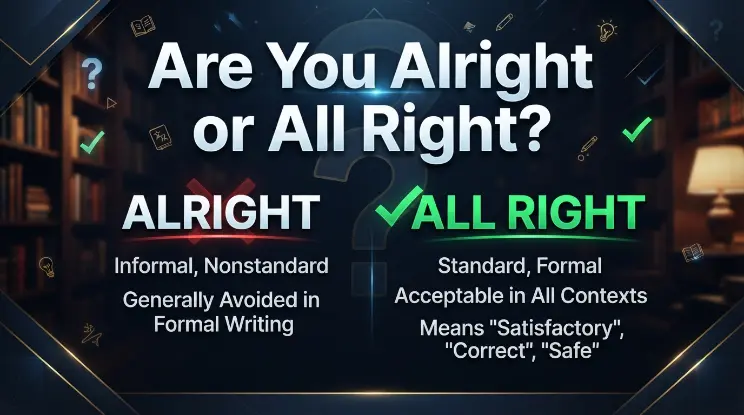
“All right” is the traditional and more widely accepted spelling in standard English. It means okay, well, safe, or satisfactory and can be used when asking about someone’s condition, such as “Are you all right?” The one-word form “alright” is also very common, particularly in informal writing and British English, but some style guides still prefer “all right.” For formal, academic, or professional writing, “all right” is the safest choice.
Are You Alright or All Right She Asked
The standard sentence is “Are you all right?” she asked. Here, all right describes the person’s condition and means “Are you okay?” The quotation marks contain the exact words spoken, while she asked is the reporting clause. In formal writing, keep all right as two words. In informal writing, “Are you alright?” she asked. is also commonly seen.
All Right and Alright in a Sentence
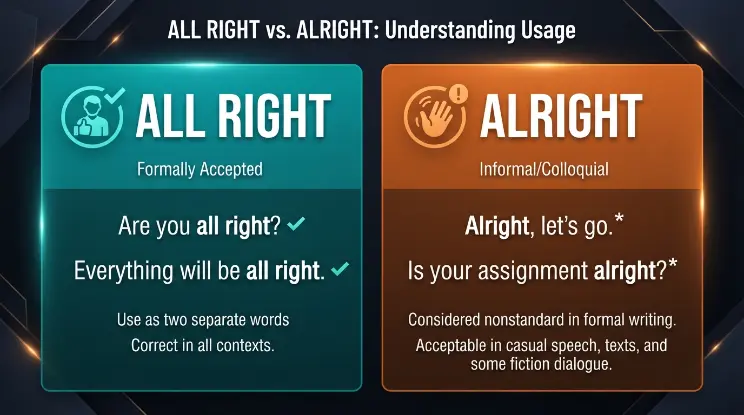
All right is used in many situations to mean okay, acceptable, or satisfactory. For example, “Are you all right?” asks whether someone is okay, while “Everything will be all right” means everything will be okay. Alright has the same general meaning and is common in everyday and informal English, such as “Are you alright?” or “It’s alright with me.” However, for formal English, all right remains the preferred form.
Key Differences Between the Words
- Formality:
- All right: Standard and formal. ✅
- Alright: Informal and nonstandard. ⚠️
- All right: Standard and formal. ✅
- Grammar Acceptance:
- All right: Accepted by all major dictionaries and style guides. ✅
- Alright: Some dictionaries accept it, but most formal style guides discourage it. ⚠️
- All right: Accepted by all major dictionaries and style guides. ✅
- Writing Context:
- All right: Suitable for essays, emails, reports, and official documents. ✅
- Alright: Best for casual texts, chat messages, or dialogue in fiction. ⚠️
- All right: Suitable for essays, emails, reports, and official documents. ✅
- Meaning: Both words mean “correct,” “okay,” or “satisfactory,” but all right is universally recognized.
Comparison Table
| Word | Meaning | Usage | Example |
| All right | Correct, acceptable, satisfactory | Formal & informal writing | Everything will be all right. |
| Alright | Same as “all right” but informal | Casual writing or dialogue | “Alright, I’ll see you later.” |
Examples in Sentences
All Right
- I’m glad to hear that you’re all right.
- The project is progressing all right, no need to worry.
- It’s all right to ask questions during the lecture.
- Are you all right with this plan?
- She reassured him that everything would be all right.
Alright
- “Alright, let’s grab some lunch,” he said.
- I think it’s alright if we start a bit later.
- She nodded and said, “Alright, I’ll help you.”
- Is it alright if I borrow your pen?
- Everything seems alright at the office today.
Common Mistakes
| Incorrect Usage | Correct Usage |
| Is everything alright? (formal writing) | Is everything all right? |
| I hope you’re doing alright in your exams. | I hope you’re doing all right in your exams. |
| She said it will be alright. | She said it will be all right. |
Tip: When in doubt, always use all right for formal writing.
Tips to Remember the Difference
- Split “all right”: Think of it as two words — “all” + “right.” If it makes sense as separate words, it is correct.
- ✅ All + right = All right
- ❌ Al + right = Alright (informal)
- ✅ All + right = All right
- Formal Writing Rule: Use all right in essays, emails, and reports.
- Casual Rule: Alright is okay in text messages or dialogue but avoid it in official documents.
- Mnemonic: “All correct = All right.” This helps you remember that the formal, correct form has a space.
When to Use Each Word
- All Right:
- Writing school essays or academic papers.
- Professional emails or reports.
- Instructions or formal communication.
- Writing school essays or academic papers.
- Alright:
- Casual texting or messaging.
- Informal social media posts.
- Dialogue in novels or scripts.
- Casual texting or messaging.
Grammar Rules
- All right is always treated as an adjective or adverb:
- Adjective: The results are all right.
- Adverb: She did all right in the exam.
- Adjective: The results are all right.
- Alright follows the same usage but is considered nonstandard.
- Avoid using alright in formal contexts it may be marked as incorrect.
Synonyms or Related Words
- Okay / OK
- Fine
- Satisfactory
- Acceptable
- Correct
Example:
- Everything is fine. ✅
- Everything is all right. ✅
- Everything is alright. ⚠️ (informal)
Frequently Asked Questions (FAQs)
- Is “alright” incorrect?
Not always, but it’s informal and often considered nonstandard. Use all right in formal writing. - Can I use “alright” in emails?
Only in casual emails. Avoid it in professional or academic emails. - Are “all right” and “alright” interchangeable?
Mostly yes in informal contexts, but all right is safer for formal writing. - Why do people use “alright”?
It is shorter, easier to type, and common in casual speech. - Can “all right” be used as a question?
Yes: “Are you all right?” is correct. - Which one is preferred in British vs American English?
- All right is standard in both.
- Alright is sometimes more accepted in British informal writing.
- All right is standard in both.
Conclusion
The confusion between all right and alright is common, but the rules are simple. Use all right for formal writing, emails, and professional documents, and reserve alright for casual conversation or informal texts. Remember: when in doubt, all right is always the safer, correct choice. By keeping these tips in mind, your writing will always look polished and professional.