Have you ever wondered whether you should say “hone in” or “home in”? You’re not alone. This is one of the most commonly confused phrases in English, and many people search for “hone in or home in” to find the correct usage. Even native speakers sometimes mix them up because both phrases sound similar and seem to mean almost the same thing.
Understanding the difference between hone in and home in is important if you want to improve your writing and speaking skills. Using the wrong phrase can make your communication less clear or even sound incorrect in formal contexts. Whether you’re a student, a professional, or just someone who loves learning English, knowing the right usage will boost your confidence.
In this detailed guide, you will learn:
- The exact meanings of hone in and home in
- The key differences between them
- When and how to use each correctly
- Simple tips to remember the difference easily
Quick Answer
The correct and original phrase is “home in.” It means to move toward a target or focus on something.
“Hone in” is widely used today, but it started as a mistake. However, it is now accepted in informal English and means to improve or sharpen focus.
Meaning and Definition of Each Word
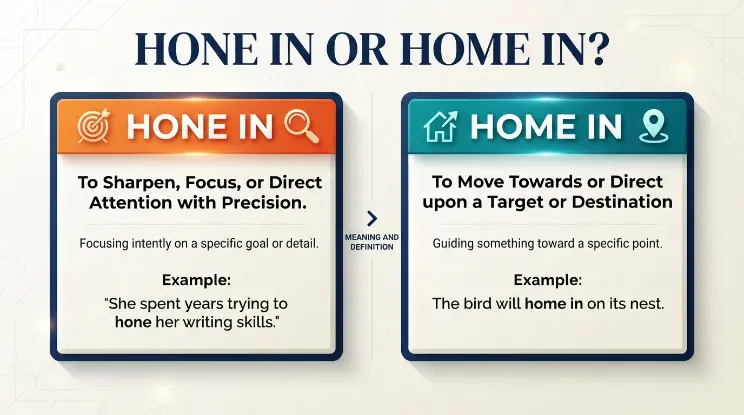
What Does “Home In” Mean?
Definition:
“Home in” means to move directly toward a target or focus on something with accuracy.
Simple Explanation:
It is often used when someone or something is getting closer to a goal, idea, or target.
Examples:
- The missile homed in on its target.
- The teacher quickly homed in on the student’s mistake.
- Detectives home in on suspects during investigations.
What Does “Hone In” Mean?
Definition:
“Hone” means to sharpen or improve something. So, “hone in” is often used to mean focusing more clearly or improving focus.
Simple Explanation:
Although originally incorrect, “hone in” is now commonly used to mean concentrating on something carefully.
Examples:
- She honed in on the main problem.
- The team honed in on improving their strategy.
- He is trying to hone in on his skills.
Hone in on Synonym
“Hone in on” is commonly used to mean focus closely on, concentrate on, zero in on, target, or narrow in on something. In everyday English, it is often used when someone directs their attention toward a specific person, problem, detail, or goal. For example, The researchers honed in on the main cause of the problem. Strictly speaking, “hone” traditionally means to sharpen or refine, while “home in on” means to move or focus directly toward a target.
Hone in on an Idea
“Hone in on an idea” means to focus closely on a particular idea and develop, refine, or examine it further. It suggests giving special attention to one idea rather than considering many possibilities. For example, The team honed in on an idea that could improve the company’s website. In careful formal writing, “home in on an idea” or “focus on an idea” may be preferred if the intended meaning is to concentrate on a target.
Hone in Etymology
The expression “hone in on” is often considered a blend of “hone” and “home in on.” Hone originally refers to sharpening something, especially a blade, and figuratively came to mean improving or refining a skill or idea. Home in on developed from the idea of moving toward or directing oneself toward a target, similar to a homing device. Over time, “hone in on” became common in American English, although “home in on” is the traditional expression for directing attention toward a target.
Key Differences Between Hone In and Home In
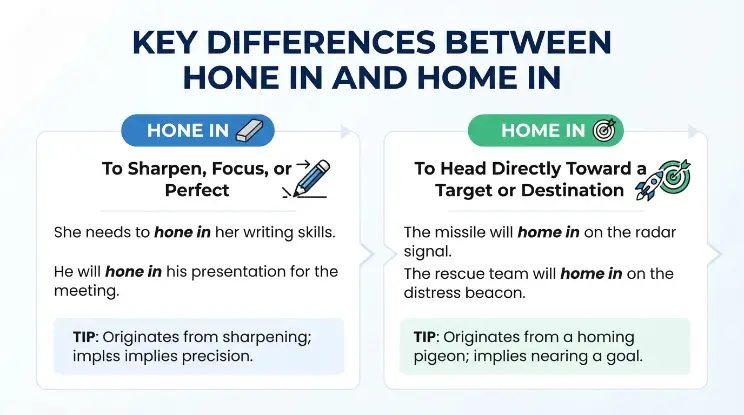
Here are the main differences:
- Origin:
- Home in is the original and correct phrase.
- Hone in started as a mistake but became popular.
- Meaning:
- Home in = move toward a target or focus.
- Hone in = sharpen or improve focus.
- Usage:
- Home in is preferred in formal writing.
- Hone in is acceptable in informal use.
- Accuracy:
- Home in is technically correct.
- Hone in is widely accepted but less precise.
Comparison Table
| Word/Phrase | Meaning | Usage | Example |
| Home in | Move toward a target | Formal & correct | The plane homed in on the runway |
| Hone in | Focus or improve | Informal & modern | She honed in on the key issue |
Home in on or hone in on
| Point | Home in on | Hone in on |
|---|---|---|
| Meaning | To move or focus toward a particular target, subject, or goal | Traditionally, hone means to sharpen, improve, or refine something |
| Standard usage | ✅ Correct and established expression | ⚠️ Commonly used, but traditionally considered a variation/error when intended to mean “move toward a target” |
| Origin/idea | Related to homing—moving toward a destination or target | Hone means to sharpen or refine, as in honing a skill |
| Meaning when used for focus | Focus closely on something | Focus closely on something |
| Example | The investigation homed in on the main suspect. | The investigation honed in on the main suspect. |
| Recommended in formal writing | Home in on | Prefer home in on when meaning “focus/move toward a target” |
| Memory tip | Home = move toward a target 🏠🎯 | Hone = sharpen/refine 🔪 |
Examples in Sentences
Using “Home In”
- The rescue team homed in on the missing hikers.
- Scientists home in on the cause of diseases.
- The camera homed in on the actor’s face.
- Police homed in on the suspect quickly.
Using “Hone In”
- He honed in on his writing skills.
- The company honed in on customer needs.
- She honed in on the details of the project.
- They honed in on improving their performance.
Common Mistakes
Many people confuse these two phrases. Here are some common mistakes:
❌ Incorrect:
- The dog honed in on the scent.
✔️ Correct: - The dog homed in on the scent.
👉 Why? Because it’s about moving toward a target, not improving something.
❌ Incorrect:
- The team home in their skills.
✔️ Correct: - The team hone their skills.
👉 “Hone” should be used alone when talking about improving skills.
❌ Incorrect:
- The missile honed in on its target (formal context)
✔️ Correct: - The missile homed in on its target
👉 Use “home in” in technical or formal writing.
Tips to Remember the Difference
Here are some easy tricks:
1. Think of “Home” as a Target
- “Home in” = going home (toward a destination)
- If something is moving toward a goal → use home in
2. Think of “Hone” as Sharpening
- “Hone” = sharpen (like a knife or skill)
- If improving something → use hone
3. Replace the Word Trick
- If you can replace it with “focus on” → both may work, but home in is safer
- If you mean “improve” → use hone
When to Use Each Word
Use “Home In” When:
- Talking about moving toward a target
- Describing focus in a precise way
- Writing formally or academically
Examples:
- The radar homed in on the object.
- The discussion homed in on the main issue.
Use “Hone In” When:
- Talking about improving focus (informally)
- Speaking casually
- Writing blogs or conversational content
Examples:
- Let’s hone in on the key ideas.
- She honed in on her strengths.
Grammar Rules (If Applicable)
- “Home in” is a phrasal verb
- Past tense: homed in
- Present: home in
- “Hone” is a regular verb
- Past tense: honed
- Present: hone
Important Rule:
👉 Do not confuse “hone” (improve) with “home” (target or direction).
Synonyms or Related Words
For “Home In”
- Focus on
- Zero in on
- Target
- Aim at
For “Hone”
- Improve
- Sharpen
- Refine
- Develop
Frequently Asked Questions (FAQs)
1. Is “hone in” grammatically correct?
Yes, it is now accepted in informal English, but it was originally considered incorrect.
2. Which is more correct: “hone in” or “home in”?
“Home in” is more correct and should be used in formal writing.
3. Why do people say “hone in” instead of “home in”?
Because “hone” means to sharpen, people think it fits the idea of focusing better.
4. Can I use “hone in” in professional writing?
It’s better to use “home in” in formal or professional contexts.
5. What does “home in on something” mean?
It means to focus on or move directly toward something.
6. Is “hone in on skills” correct?
Yes, but better phrasing is:
- “Hone your skills”
- “Improve your skills”
Conclusion
The confusion between “hone in” and “home in” is very common, but now you know the difference clearly. The original and correct phrase is “home in,” which means to move toward a target or focus on something. On the other hand, “hone in” has become popular and is accepted in casual use, but it’s not always the best choice in formal writing.
To stay safe, remember:
- Use home in for accuracy and formal contexts
- Use hone when talking about improving skills
With these simple rules and tips, you can confidently use the right phrase every time!
READ MORE ABOUT THIS
Calfs or Calves: Which One Is Correct and How to Use It Properly?
Goodnight or Good Night: Which One Is Correct
Up to Date or Up-to-Date: What’s the Difference and How to Use Correctly?
Defense or Defence: The Difference and Which One Should You Use?
Clearer or More Clear: Which One Should You Use?
Any More or Anymore: What’s the Difference and How to Use.