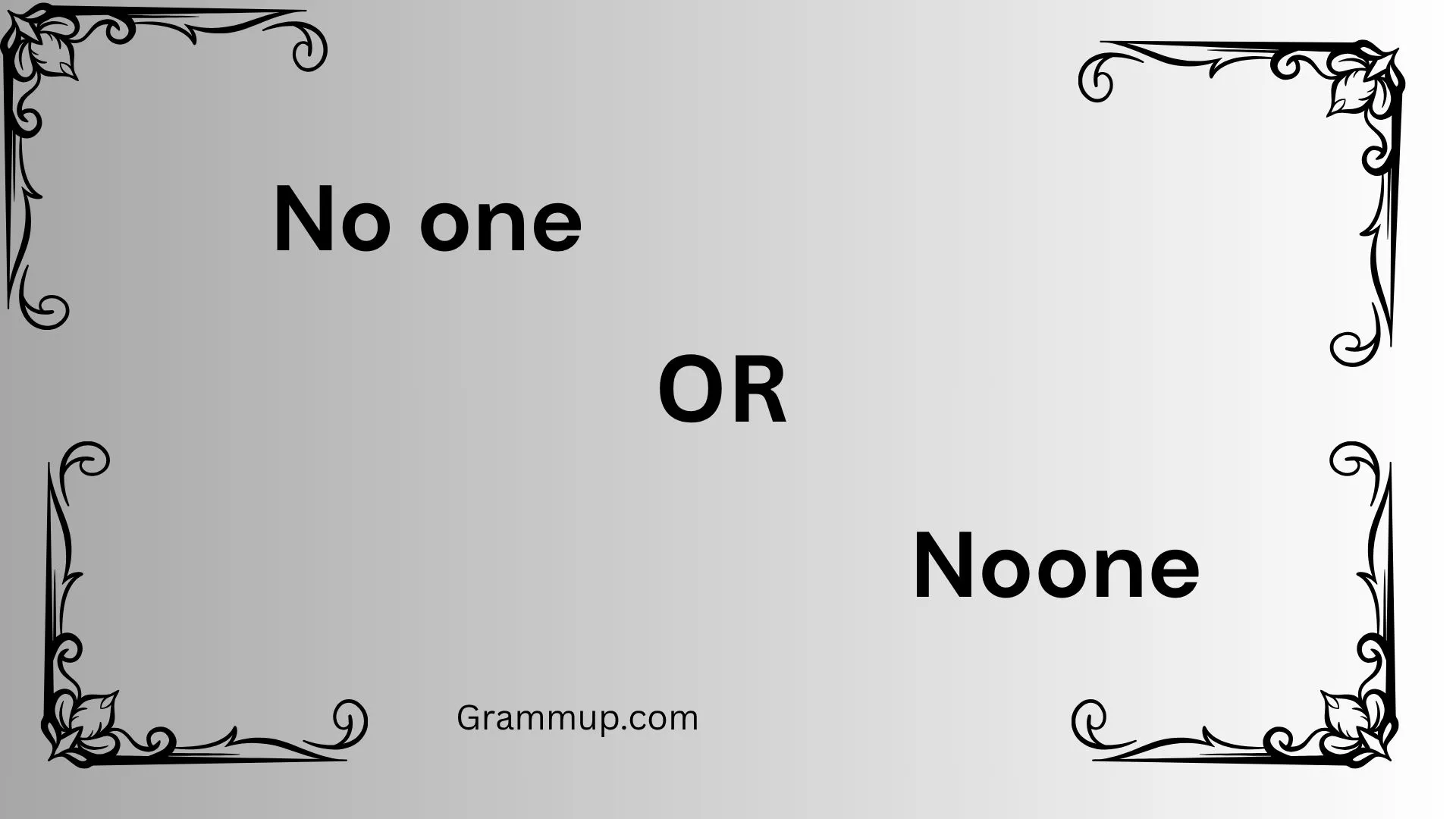
Understanding the difference between “no one” and “noone” can be tricky for many English learners. These two forms may sound the same when spoken, but only one is correct in standard English writing.
Many people often search for “[no one or noone]” because they want to write properly in emails, essays, or messages. Using the wrong form can make your writing look unprofessional or careless.
In this article, we will clarify the confusion between “no one” and “noone.” You will learn the correct usage, common mistakes, grammar rules, and easy tips to remember which form to use. By the end, you will feel confident writing sentences with the right word every time.
Quick Answer
“No one” is the correct form in English to indicate nobody or not a single person. “Noone” is a common misspelling and should be avoided in formal and informal writing. Always write “no one” as two separate words.
Meaning and Definition of Each Word
1. No one
- Definition: “No one” means nobody; not a single person.
- Explanation: It is used when referring to the absence of people.
- Example sentences:
- No one came to the party last night.
- I tried calling, but no one answered.
- No one came to the party last night.
2. Noone
- Definition: “Noone” is incorrect in standard English.
- Explanation: Many people mistakenly write “noone” because it sounds the same as “no one.” It is not accepted in dictionaries or grammar guides.
- Example sentence:
- ❌ Noone is allowed here. (Incorrect)
- ✅ No one is allowed here. (Correct)
- ❌ Noone is allowed here. (Incorrect)
Key Differences Between the Words
- Correctness: “No one” is correct; “noone” is incorrect.
- Usage: Use “no one” to indicate nobody. Never use “noone” in formal writing.
- Appearance: “No one” is always written as two words.
- Common Mistake: People often merge it into “noone” because of pronunciation.
Quick Tip: If it sounds like “no one,” write it as two words, not one.
No One Person Meaning
“No one” means not any person or nobody. It is used to refer to zero people and is normally written as two separate words. For example, No one person can solve every problem alone means that there is not a single person who can do everything alone.
No One Spelling UK
In British English, the standard spelling is “no one”, with a space between the two words. “Noone” is incorrect, while “no-one” may be seen in some British writing but “no one” is the modern standard form. For example, No one knows the answer is correctly written without a hyphen.
Comparison Table
| Word | Meaning | Usage | Example |
| No one | Nobody | Always correct | No one knew the answer. |
| Noone | Incorrect form | Avoid using | ❌ Noone knew the answer. ✅ No one knew the answer. |
Examples in Sentences
Correct Usage of “No one”:
- No one could solve the puzzle.
- I looked around, but no one was there.
- No one wants to wait in the rain.
- She said no one should enter the room.
- No one believed his story.
Incorrect Usage of “Noone”:
- ❌ Noone is coming to the meeting.
- ❌ I asked, but noone replied.
Common Mistakes
- Incorrect: Noone likes homework.
- Correct: No one likes homework.
- Incorrect: Noone can stop me now.
- Correct: No one can stop me now.
- Incorrect: I saw noone at the park.
- Correct: I saw no one at the park.
Tip: Always double-check spelling. If you’re unsure, separate it into “no one.”
Tips to Remember the Difference
- Two Words: Remember, “no one” is always written as two words.
- Sound Trick: Say the sentence aloud; if it sounds like “no one,” write it as two words.
- Dictionary Check: “Noone” does not appear in dictionaries. “No one” does.
- Think Negation: The word indicates nobody, so treat it as a pronoun.
When to Use Each Word
- Use “no one”:
- When you mean nobody or not a single person.
- Example: No one enjoyed the movie.
- When you mean nobody or not a single person.
- Never use “noone”:
- Avoid in essays, emails, social media, or any formal writing.
- Example: ❌ Noone will approve this. ✅ No one will approve this.
- Avoid in essays, emails, social media, or any formal writing.
Grammar Rules
- “No one” as a pronoun:
- Acts like “nobody.”
- Example: No one is perfect.
- Acts like “nobody.”
- Verb agreement:
- Treat “no one” as singular, not plural.
- Example: No one is allowed inside. (Not “are allowed”)
- Treat “no one” as singular, not plural.
- Capitalization:
- At the beginning of a sentence: No one.
- In the middle: no one.
- At the beginning of a sentence: No one.
Synonyms or Related Words
- Nobody
- None
- Not a soul
- No person
Example:
- Nobody knows the answer. ✅
- No one knows the answer. ✅
Frequently Asked Questions (FAQs)
Q1: Can I write “noone” in casual messages?
A1: It’s still incorrect. Always use “no one,” even in informal writing.
Q2: Is “no one” two words or one word?
A2: Two words. “Noone” is never correct.
Q3: What is the difference between “nobody” and “no one”?
A3: Both mean the same, but “no one” is slightly more formal than “nobody.”
Q4: Can “no one” be used at the start of a sentence?
A4: Yes, for example: No one expected the surprise.
Q5: Is “no one” singular or plural?
A5: Singular. Always use singular verbs with it.
Q6: Are there any shortcuts for remembering this?
A6: Think: “No one = two words,” like “not a single person.”
Conclusion
In English, the correct form is “no one” two separate words that mean nobody. “Noone” is a common misspelling and should never be used. Remember, treat “no one” as singular, use it in formal or informal writing, and always check your spelling. Following these tips will help you avoid mistakes and write clearly.