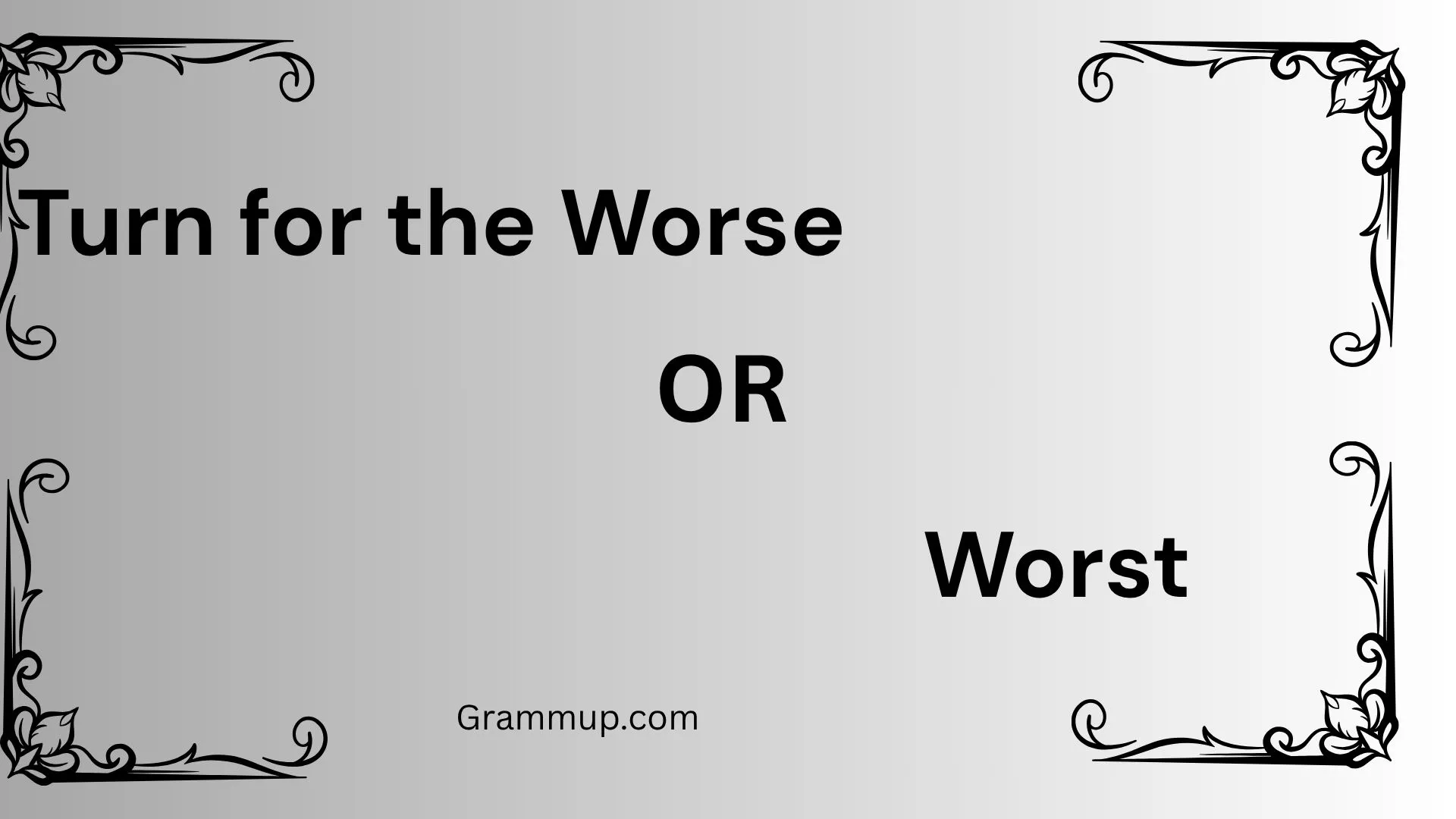
Many people often get confused between “turn for the worse” and “turn for the worst”. Both phrases sound similar, but only one is grammatically correct in English. Misusing them can make your writing or speech sound awkward or incorrect.
People search for “turn for the worse or worst” because they want to make sure they are expressing negative changes properly. This confusion is common among beginners and even intermediate English learners. Understanding the difference helps you communicate clearly and professionally.
In this article, you will learn the correct usage of “turn for the worse” versus “turn for the worst”, see examples in sentences, common mistakes, and tips to remember the difference. By the end, you’ll be confident using the right phrase in any situation.
Quick Answer
The correct phrase is “turn for the worse”, not “turn for the worst.” Use it when describing a situation that has deteriorated or become worse. “Worst” is an adjective used to describe the most negative quality of something, not a change in condition.
Meaning and Definition of Each Word
Turn for the Worse
Definition: A phrase used to describe a situation that has gotten worse or deteriorated.
Explanation: When something changes negatively, we say it has “turned for the worse.”
Example Sentence:
- After the storm, the weather turned for the worse, making travel impossible.
Worst
Definition: The superlative form of “bad,” used to describe the most negative quality of something.
Explanation: “Worst” describes something that is the most terrible or unfavorable among a group.
Example Sentence:
- This is the worst movie I have ever watched.
Key Differences Between the Words
- Phrase vs. Adjective: “Turn for the worse” is a complete phrase indicating change, while “worst” is an adjective describing quality.
- Usage: “Turn for the worse” is used for situations or conditions; “worst” is used to rank or describe extremes.
- Grammar: “Worse” is comparative (something is more negative than before), and “worst” is superlative (the most negative in comparison).
Comparison Table
| Word/Phrase | Meaning | Usage | Example |
| Turn for the Worse | Situation becomes worse | To describe negative changes | His health turned for the worse last week. |
| Worst | The most negative or unfavorable | To compare or rank | This is the worst decision I’ve ever made. |
Examples in Sentences
Turn for the Worse
- The patient’s condition turned for the worse after the surgery.
- Negotiations turned for the worse when both parties refused to compromise.
- Things turned for the worse when the company lost its biggest client.
Worst
- That was the worst exam of my life.
- She had the worst headache yesterday.
- Among all the options, this is the worst choice.
Common Mistakes
| Incorrect Usage | Correct Usage |
| The situation turned for the worst. | The situation turned for the worse. |
| He made the worse mistake ever. | He made the worst mistake ever. |
| Today is the worse day of my life. | Today is the worst day of my life. |
Tip: Remember, “worse” describes a change; “worst” ranks something as the most negative.
Tips to Remember the Difference
- Worse = Change: Think of “worse” as something that is getting worse than before.
- Worst = Extreme: Think of “worst” as the ultimate negative point among several things.
- Phrase clue: If you see “turn for the ___”, the blank is always worse, not worst.
When to Use Each Word
Use “Turn for the Worse” When:
- Describing health, weather, or situations that deteriorate.
- Telling stories about events that go negatively.
- Talking about ongoing changes.
Example: The economy turned for the worse after the global crisis.
Use “Worst” When:
- Comparing things or ranking them.
- Talking about extreme negative qualities.
- Describing experiences, choices, or items.
Example: Of all the pizzas I tried, this one is the worst.
Grammar Rules
- Worse: Comparative adjective; used to compare two states.
- Example: His condition is worse than yesterday.
- Example: His condition is worse than yesterday.
- Worst: Superlative adjective; used to compare three or more things.
- Example: This is the worst day of the week.
- Example: This is the worst day of the week.
- Turn for the worse: Fixed phrase, always uses worse, not worst.
Synonyms or Related Words
- Worse: deteriorate, decline, degenerate
- Worst: poorest, least favorable, most terrible
- Turn for the worse: take a bad turn, go downhill
Frequently Asked Questions (FAQs)
1. Can I say “turn for the worst”?
No. The correct phrase is “turn for the worse.” Using “worst” here is grammatically incorrect.
2. Is “worse” always comparative?
Yes, “worse” compares two states or conditions, indicating one is more negative.
3. Can “worst” be used in a phrase like “turn for the worst”?
No, “worst” is used for ranking, not changes in condition.
4. What is the difference between “worse” and “worst”?
“Worse” compares two things; “worst” identifies the most negative among three or more.
5. Are there any memory tricks to remember this?
Yes, think: “Turn = change → worse”, and “Worst = extreme → ranking.”
6. Can “turn for the worse” be used in formal writing?
Absolutely! It is correct in both formal and informal contexts.
Conclusion
In English, the phrase “turn for the worse” is correct when describing a situation that has deteriorated. Using “turn for the worst” is a common mistake. Remember: worse = change, worst = extreme. By practicing with examples and remembering the tips above, you can confidently use the correct phrase in everyday conversation or writing.