Creating useful content is not only about choosing a keyword and filling a page with information. Readers want content that is easy to understand, practical, memorable, and connected to real situations. This is where the Your Topics | Multiple Stories Strategy can make content more effective.
The idea is simple: instead of explaining a topic from only one angle, you use several related stories, examples, experiences, or situations to explain different parts of the same subject. Each story has a specific purpose, and together they create a complete picture.
A strong Multiple Stories Strategy can work for bloggers, businesses, marketers, educators, and website owners. It can help transform ordinary explanations into engaging Story-Based Content while giving readers practical examples they can understand.
This guide explains how the strategy works, how to choose the right stories, how to organize them, how to use keywords naturally, and how to turn multiple stories into an effective Content Creation Strategy.
What Is the Your Topics | Multiple Stories Strategy?
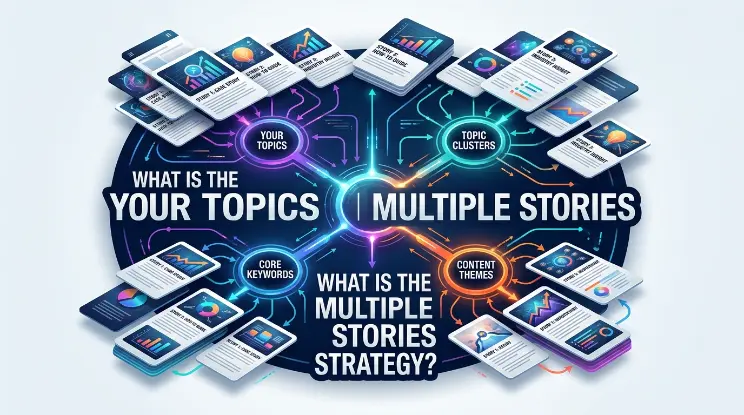
The Your Topics | Multiple Stories Strategy is a storytelling-based content method that uses multiple connected stories to explain one main topic.
The Core Idea
Think of your main topic as the center of your article. Around that topic, you create several smaller stories.
For example, imagine you are writing about time management.
You could use:
- A student struggling with assignments
- An employee dealing with meetings
- A freelancer managing several clients
- A business owner trying to delegate tasks
These are different situations, but they all support the same topic: time management.
This is the basic principle behind the Multiple Stories Content Strategy.
Why Multiple Stories Are Different
A normal article might explain a topic through definitions, facts, tips, and lists. Those elements are useful, but adding stories gives readers something concrete to visualize.
Instead of simply saying that planning saves time, you can show a person who spends ten minutes planning their day and avoids several hours of unnecessary work.
The story demonstrates the idea rather than simply stating it.
The One-Topic Rule
The most important rule is that all stories should connect to one central subject.
You should not add a story just because it is interesting. It should explain an important point, demonstrate a problem, show a solution, or provide a different perspective.
This keeps your Topic-Based Content Strategy focused.
Why a Multiple Stories Strategy Works

Stories have been used to communicate ideas for centuries because people naturally connect with situations, characters, problems, and outcomes.
Stories Turn Ideas Into Situations
Some concepts are difficult to understand when they remain abstract.
For example, “consistency improves productivity” is a general statement.
A short example can make it clearer:
A writer publishes one useful article every week instead of writing ten articles in one weekend and then stopping for several months.
The reader can immediately understand what consistency looks like.
Different Perspectives Increase Relevance
Readers have different experiences.
One person may be a student, another may be a business owner, and another may be a professional. Multiple perspectives allow the same article to speak to different groups.
This makes the Multiple Storytelling Approach particularly useful for broad topics.
Stories Make Long Content Easier to Read
Long articles can feel repetitive when every section follows the same format.
Stories introduce variety.
A useful article might move from:
Explanation → Story → Lesson → Example → Practical Tip
This creates a natural rhythm that helps maintain reader interest.
Stories Make Content More Memorable
Readers may forget a general statement, but a relatable situation can stay in their memory.
That is one reason Storytelling in Content Marketing can be effective when the stories are relevant and connected to useful information.
Multiple Stories Strategy vs Traditional Content Strategy

Both approaches can be useful. The difference is how information is presented.
| Traditional Content Strategy | Multiple Stories Strategy |
| Mainly uses facts and explanations | Combines explanations with stories |
| Often follows one perspective | Can present multiple perspectives |
| May feel instructional | Can feel more relatable |
| Uses examples occasionally | Makes examples a central part |
| Usually explains what to do | Can show how and why it works |
| Works well for simple answers | Works well for detailed topics |
| Often follows a linear structure | Can connect several situations |
When Traditional Content Is Better
A traditional format is often better when readers need a quick answer.
For example, a simple spelling question, definition, calculation, or short technical instruction may not need several stories.
When Multiple Stories Are Better
A Multiple Stories Strategy works especially well for topics involving:
- Experiences
- Challenges
- Personal development
- Business
- Education
- Customer problems
- Career decisions
- Mistakes
- Successes
- Life lessons
The format should always match the search intent.
The Main Benefits of Using Multiple Stories
Using several well-planned stories can improve both reader experience and content quality.
Better Audience Engagement
Stories create movement within an article.
Instead of reading paragraph after paragraph of explanations, readers encounter different situations that demonstrate the subject.
This can make the content feel more dynamic.
More Practical Information
A story can show how an idea works in everyday life.
For example, instead of giving five generic productivity tips, you could show how a freelancer applies each tip during a busy workweek.
Stronger Emotional Connection
Stories can communicate emotions such as frustration, excitement, confusion, confidence, or relief.
This does not mean every article needs dramatic storytelling. Even a simple relatable situation can create a stronger connection.
More Content Depth
Multiple perspectives allow you to explore different sides of a topic.
One story can explain the problem, another can demonstrate the solution, and another can show a common mistake.
This creates depth without simply repeating the same information.
More Original Content
Many websites cover the same subjects.
Adding original examples and perspectives can make your Storytelling Content Strategy more distinctive.
The information may be similar, but your presentation can be more useful and memorable.
Natural Keyword Opportunities
Detailed content creates opportunities to use related keywords naturally.
For example, an article about storytelling can naturally discuss:
- Storytelling strategy
- Content creation
- Audience engagement
- Blog storytelling
- Content marketing
- SEO writing
- Story-based content
This is better than forcing the same keyword repeatedly.
How to Build the Your Topics Multiple Stories Strategy
A successful strategy needs planning. The following framework gives you a practical process you can repeat for different topics.
Step 1: Choose One Clear Main Topic
Start with one central subject.
Write it at the top of your content plan.
For example:
Main topic: How to Improve Communication Skills
Then identify related areas such as:
- Listening
- Speaking
- Workplace communication
- Confidence
- Body language
- Written communication
This prevents your article from becoming too broad.
Step 2: Identify Your Target Reader
Think about who will benefit from your content.
Ask yourself:
- What does this reader already know?
- What problem are they trying to solve?
- What examples would they recognize?
- What questions might they have?
Your answers will help you select relevant stories.
Step 3: Research the Topic
Before writing stories, research the subject.
Look at:
- Common questions
- Related topics
- Frequently discussed problems
- Search intent
- Existing content gaps
- Useful examples
Research helps ensure that storytelling supports useful information rather than replacing it.
Step 4: Create a Story Bank
Make a list of possible stories before you start writing.
For each story, record:
| Story | Perspective | Problem | Lesson |
| Story 1 | Student | Poor planning | Create a schedule |
| Story 2 | Employee | Constant interruptions | Set focus periods |
| Story 3 | Freelancer | Too many tasks | Prioritize work |
| Story 4 | Manager | Lack of delegation | Build a team system |
This simple table makes the strategy easier to organize.
Step 5: Give Every Story a Job
Every story should answer one question:
Why is this story here?
Possible purposes include:
- Introducing a problem
- Explaining a concept
- Showing a mistake
- Demonstrating a solution
- Providing motivation
- Comparing two approaches
- Showing a transformation
If you cannot identify the purpose, the story probably does not belong in the article.
Step 6: Connect Stories With Lessons
Never leave readers to guess why a story matters.
After an example, explain the lesson.
A simple structure is:
Situation → Problem → Action → Result → Lesson
This format keeps storytelling educational.
Step 7: Arrange Stories in a Logical Order
The order matters.
You could organize your stories from:
- Beginner to advanced
- Problem to solution
- Failure to success
- Simple to complex
- Individual to business
- Past to present
Choose the order that makes the most sense for your subject.
The Best Types of Stories for Content

Different story formats can serve different purposes.
Personal Experience Stories
Personal experiences can make an article feel authentic.
They can explain how someone faced a problem, made a decision, learned something, or achieved a result.
The important part is the lesson.
Customer Stories
Businesses can use customer experiences to show how a product or service addresses a real problem.
Instead of saying that a product is useful, a customer story can demonstrate how it is used.
Success Stories
Success stories can motivate readers while showing a process.
A strong success story should explain the steps behind the result instead of simply celebrating the outcome.
Failure Stories
Failure can provide valuable lessons.
A story about a mistake can explain what went wrong, why it happened, and what someone could do differently next time.
Hypothetical Stories
You can also create realistic scenarios when you do not have a real story.
For example:
“Imagine a small business owner who receives dozens of customer messages every morning…”
This gives the reader a situation they can easily understand.
Before-and-After Stories
These stories focus on transformation.
You show what the situation looked like before a change and what happened afterward.
This format is particularly useful for educational and business content.
A Practical Example of the Strategy
Suppose you want to write an article about better study habits.
Instead of writing a basic list of study tips, you could build the article around several students.
Story One: The Distracted Student
A student sits down to study but checks social media every few minutes.
The lesson is that removing distractions can improve concentration.
Story Two: The Overworked Student
Another student studies for six hours without meaningful breaks.
The lesson is that study quality matters more than simply increasing study hours.
Story Three: The Unorganized Student
A student has several upcoming exams but does not have a revision plan.
The lesson is that planning can reduce last-minute pressure.
Story Four: The Successful Student
A student creates a weekly schedule, studies in focused sessions, reviews notes, and takes regular breaks.
The lesson is that effective study habits involve a system rather than one single trick.
All four stories support the same topic.
That is how Story-Based Content can make educational content more practical.
Advanced Storytelling Techniques
Once you understand the basic framework, you can make your content more effective with a few advanced techniques.
Start With a Specific Situation
Specific situations are easier to visualize.
Instead of:
“People struggle with productivity.”
Try:
“An employee opens their laptop at 9 a.m. and immediately spends the next two hours answering messages.”
The second version creates a clear picture.
Show the Problem Before the Solution
Readers understand solutions better when they first understand the problem.
Use this progression:
Problem → Consequence → Realization → Solution → Result
Use Different Perspectives
Avoid making every story sound identical.
You might show the same topic through the perspective of:
- A beginner
- An expert
- A customer
- A manager
- A student
- A business owner
Different perspectives add depth.
Keep Stories Concise
A blog story does not need to become a novel.
Remove details that do not contribute to the lesson.
The goal is useful storytelling, not storytelling for its own sake.
Use Data Alongside Stories
Stories and factual information can work together.
For example, introduce a situation through a short story and then provide research, statistics, or practical guidance to explain the broader lesson.
This creates a stronger Content Writing Strategy.
How Bloggers Can Use Multiple Stories
Bloggers can use this strategy across many types of articles.
Educational Articles
Use different learner experiences to explain a concept.
How-To Guides
Show how different people apply the same process.
List Articles
Instead of simply listing tips, give a short example for important points.
Comparison Articles
Use different situations to explain when each option may be useful.
Personal Development Content
Use stories showing challenges, decisions, mistakes, and progress.
This approach can make a blog more relatable without sacrificing useful information.
How Businesses Can Use Multiple Stories
Businesses can also use the strategy as part of their Content Marketing Strategy.
Customer Case Studies
Show the customer’s original problem, the solution, and the result.
Product Education
Use realistic situations to explain how a product works.
Brand Storytelling
Explain the company’s journey, challenges, values, and development.
Employee Experiences
Employee stories can provide a human perspective and demonstrate expertise or company culture.
Problem-Solution Content
Start with a common customer problem and use a story to demonstrate how the problem can be addressed.
How to Use the Strategy for SEO
Storytelling should support SEO rather than replace basic SEO practices.
Match Search Intent
First determine what the reader expects.
If the search requires a definition, give the definition early.
If readers want examples, provide examples.
They want instructions, provide a step-by-step process.
Stories should make the answer better, not hide it.
Use the Primary Keyword Naturally
Your primary keyword is:
Your Topics | Multiple Stories Strategy
Use it in important locations such as:
- H1
- Introduction
- Relevant body section
- One appropriate heading if natural
- Conclusion
Avoid repeating the exact phrase unnecessarily.
Use Secondary Keywords Naturally
Useful secondary keywords include:
- Multiple Stories Strategy
- Your Topics Strategy
- Multiple Stories Content Strategy
- Multiple Storytelling Approach
- Storytelling Content Strategy
- Story-Based Content
- Content Creation Strategy
- Content Writing Strategy
- Topic-Based Content Strategy
- Storytelling in Content Marketing
- Multiple Perspectives in Content
- Engaging Content Strategy
- SEO Content Strategy
- Content Marketing Strategy
- Storytelling Strategy
- Content Strategy for Multiple Topics
- How to Use Multiple Stories Strategy
- Multiple Stories Approach
- Story-Based Content Strategy
- Content Planning Strategy
Place them where they genuinely fit the meaning of the paragraph.
Add Semantic and NLP Terms
Related phrases can help establish topical context.
Useful terms include:
- storytelling in blogging
- engaging blog content
- content storytelling
- audience engagement
- content planning
- content creation
- blog storytelling
- storytelling techniques
- content marketing
- reader engagement
- content strategy
- multiple perspectives
- practical storytelling
- long-form content
- SEO-friendly content
- storytelling techniques for bloggers
Natural usage is more important than using every term repeatedly.
Common Mistakes to Avoid
A multiple-story article can lose its effectiveness when the stories are poorly planned.
Using Unrelated Stories
An interesting story is not automatically a useful story.
Every example should support the main topic.
Repeating the Same Lesson
If every story teaches the exact same thing, the article becomes repetitive.
Give each story a different purpose.
Making Stories Too Long
Long stories can bury the actual information.
Keep them focused on the topic.
Adding Stories Without Lessons
Readers should understand why the example matters.
Follow important stories with a clear takeaway.
Keyword Stuffing
Do not force keywords into sentences.
For example, repeating “Multiple Stories Strategy” in every paragraph will make the article unnatural.
Use variations and related terms instead.
Ignoring Search Intent
A beautifully written article can still fail to satisfy readers if it does not answer their actual question.
Always start with the user’s search intent.
Making Every Story Perfect
Realistic content does not always need perfect success stories.
Mistakes, obstacles, and failed attempts can make examples more educational.
A Simple Content Planning Template
Use this template before creating your next article.
Main Topic
Write the exact subject you want to cover.
Primary Keyword
Choose the main search phrase.
Secondary Keywords
List closely related terms.
Target Audience
Identify the people you want to help.
Main Problem
Write the primary problem your article solves.
Story One
Choose the first perspective and its purpose.
Story Two
Choose a different perspective and lesson.
Story Three
Add another example that provides new information.
Supporting Information
Add definitions, facts, tips, instructions, tables, or examples.
Internal Links
Identify related articles that readers may want to explore.
Final Takeaway
Summarize the main lesson and give readers a practical next step.
How Many Stories Should You Use?
There is no universal number.
The correct number depends on the article’s purpose, length, and complexity.
For Short Articles
One or two strong examples may be enough.
For Medium-Length Articles
Two to four stories can provide useful variety.
For Long-Form Articles
Several stories can work when each one introduces a new perspective.
The goal is not to maximize the number of stories.
The goal is to maximize usefulness.
How to Keep Multiple Stories Organized
Organization becomes especially important in long-form content.
Use Clear H3 Headings
Each major story or supporting idea can receive an H3 heading.
This helps readers scan the article quickly.
Use Transitions
Transitions explain the relationship between sections.
For example:
“While the previous example shows the problem from an employee’s perspective, the next example demonstrates how a business owner can solve a similar challenge.”
Follow a Consistent Structure
You can use:
Story → Explanation → Lesson → Action
Repeating this basic pattern creates consistency without making the article boring.
Internal Linking Opportunities
A detailed SEO Content Strategy should connect related articles across your website.
Link to Supporting Topics
If you mention keyword research, link to your keyword research guide.
If you discuss content planning, link to your content planning article.
You discuss storytelling, link to a detailed storytelling guide.
Build Topic Clusters
A main article can connect to supporting articles around the same subject.
For example:
Main Topic: Content Strategy
Supporting content:
- Storytelling in Blogging
- SEO Content Strategy
- Keyword Research
- Content Planning
- Audience Research
- Blog Writing
- Content Marketing
This creates a stronger Content Strategy for Multiple Topics.
Frequently Asked Questions
What is the Your Topics | Multiple Stories Strategy?
The Your Topics | Multiple Stories Strategy is a content method that uses multiple connected stories, examples, or perspectives to explain one central topic.
What is a Multiple Stories Strategy?
A Multiple Stories Strategy combines several relevant stories within one article. Each story has a specific purpose and supports the main subject.
Why should bloggers use multiple stories?
Bloggers can use multiple stories to make complex ideas easier to understand, add practical examples, increase engagement, and give readers different perspectives.
Can multiple stories improve SEO?
Multiple stories can support comprehensive and useful content, but storytelling itself does not guarantee rankings. Good SEO also requires search-intent alignment, useful information, technical optimization, and quality content.
How long should each story be?
Keep each story focused. It should contain enough information to explain the situation and lesson without distracting from the main subject.
Can I use fictional stories?
Yes. Hypothetical or fictional scenarios can be useful when clearly presented as examples rather than real experiences.
Is multiple-story content suitable for every keyword?
No. Simple definitions and quick-answer searches may not need several stories. Use this approach when examples genuinely improve understanding.
What is the difference between storytelling and a Multiple Stories Strategy?
Traditional storytelling may focus on one main narrative. A Multiple Stories Strategy uses several connected stories to explain different parts of one broader topic.
How many keywords should I use?
There is no fixed number. Focus on natural language and relevance. Use your primary keyword strategically and include secondary and semantic keywords where they fit naturally.
Can businesses use this content strategy?
Yes. Businesses can use customer stories, case studies, employee experiences, product examples, and problem-solution scenarios as part of their content marketing.
Conclusion
The Your Topics | Multiple Stories Strategy is a practical way to turn ordinary information into more engaging and useful content. Instead of explaining a subject from only one perspective, you can combine several relevant stories to demonstrate different problems, experiences, solutions, and lessons.
The key is not to add as many stories as possible. Each story should have a clear job. One can introduce a problem, another can demonstrate a solution, and another can provide a different perspective.
When combined with strong research, search intent, natural keyword placement, clear headings, internal linking, and useful examples, a Multiple Stories Content Strategy can become a valuable part of your overall Content Creation Strategy.