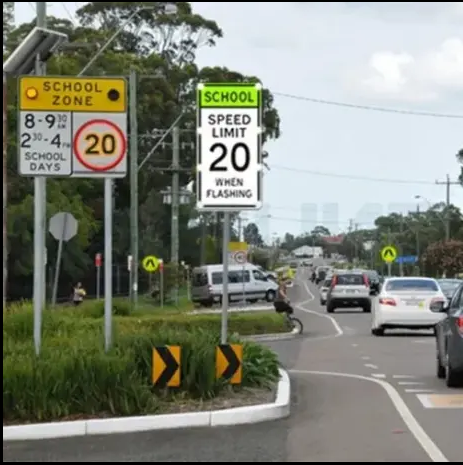
Each day at school goes the same way. The buses come in, the parents form lines to drop their children off, and hundreds of children walk on the roads with bags that are even larger than their shoulders. Among all these people, there is only one factor that guarantees safety for all the children – proper signage.
Selecting appropriate school road signs is not an easy task. It influences the behavior of drivers, their speed, and the time required for them to react in case of any emergencies. The following guide will tell about different types of school road signs, their locations, and features of buying them.
Why School Zone Signs Matter So Much
Kids are considered one of the most vulnerable road users. Children are small, harder to spot, and unpredictable compared to adults. The child could run after a ball, run across between parked cars or even miscalculate how fast the vehicle is moving towards him.
However, the driver himself might be preoccupied with something or in a hurry, particularly during rush hours in the morning and evening. Proper signing solves this problem. It gives the driver three pieces of information at once; there is a school ahead, it is time to slow down and it is time to be cautious.
The better the signs are visible and comprehensible, the faster and calmer the driver will act.
The Main Types of Road Signs for Schools
A safe school zone sign will consist of different signs rather than just one. The following are some of the common ones.
School Zone and School Ahead Signs
These are the common signs people think about when talking about a school zone. These signs come in the fluorescent yellow-green color and a unique shape called the pentagon, which is used for all school zone signs. The main purpose of these signs is to warn motorists in advance that they are in the school zone.
School Speed Limit Signs
Speed is the single most important factor that determines how damaging an accident will be. The school speed limit signs indicate reduced speed limits during particular times of day or where kids are present. Common speed limits range from 15 mph to 25 mph. Mentioning the particular hours makes it clear to the motorists what the speed limit will be.
School Crosswalk and Pedestrian Crossing Signs
Crosswalks are where students and vehicles meet, so they deserve strong visual emphasis. Pedestrian crossing signs placed at and ahead of the crosswalk, along with proper pavement markings, show drivers exactly where to stop and where kids will be walking. Fluorescent yellow-green backgrounds make these signs stand out in all lighting conditions.
Flashing Beacons and Warning Signs
Flashing beacons create movement in a sign that attracts attention much better than an ordinary panel. They work well in areas of high traffic, where there are curves or other places where drivers do not pay attention to regular signs. The beacons can be set to flash only when school is in session.
Radar Speed Feedback Signs
This kind of sign reflects the real speed of a driver’s car in real-time. It works wonders to slow down the speed of cars when a person sees his/her speed right next to the posted speed limit. These kinds of signs are also capable of collecting data of traffic that can help in identifying patterns of speeding in an area.
No Parking, No Stopping, Loading Zone, and Bus Zones
The problem with traffic in schools lies not just in the speed but congestion as well. Parking and loading zones, as well as bus zones, will help to keep traffic flowing smoothly by not having unnecessary maneuvers taking place.
Where to Locate School Signs for Maximum Effectiveness
Placement is just as important as the signs themselves. The ideal sign placed in an improper location won’t work effectively.
Warning in advance:
Locate the school signs sufficiently ahead so motorists will have enough time to reduce speed.
Zone entrance:
Place the school speed limit sign in the beginning of the lower speed limit area, and repeat the sign at regular intervals.
Crossing point:
Place the sign at the point of crossing and ahead of the crossing point so that approaching motorists will receive two warnings.
Entrances and exits:
Use the directional and parking signs at the entry and exit points of buses and parents’ vehicles.
Unobstructed vision:
Avoid blocking signs with tree branches and parked vehicles.
Sometimes, walking or driving around the zone at various times during the day will make it easier to identify potential trouble spots.
Follow MUTCD Standards
In the United States, traffic signs are guided by the Manual on Uniform Traffic Control Devices, known as the MUTCD. It sets standards for sign colors, shapes, sizes, symbols, and placement so that drivers see the same message everywhere they go.
Following these standards protects schools and local governments in two ways. First, drivers understand the signs instantly because they look familiar. Second, compliant signage helps meet legal and funding requirements. Always check your state and local rules too, since some areas add their own requirements on top of the national guidance.
Visibility and Quality Materials: Why Does a School Sign Last?
School signs are exposed to sunlight, snow, rain, and wind. This is why quality is important. Watch out for such properties as:
Reflective sheeting with a high level of reflectivity: This keeps your sign bright and visible during the day and evening, even when the weather is poor.
Aluminum panels that are resistant to corrosion and flexing and last for decades.
Ink and coating with UV protection: This protects against fading, which is one of the most common issues with fluorescent colors.
Affordable signs might help you save some money, but faded or damaged signs require replacement much earlier, and this reduces their effectiveness as safety messages.
Solar Energy-Based Signs for Schools
Previously, electronic school zone signs were expensive and time-consuming to install because they needed to be wired. This has been resolved by solar signs. The sign can be powered by a solar panel and battery to control the flashing lights or radar screen display.
A solar sign is ideal for budget-conscious or difficult-to-access schools. Just ensure that the solar sign is correctly sized according to the number of hours of operation required.
Tips for Choosing a School Signs Supplier
A good supplier will make your life much easier. Before ordering anything, keep in mind that:
- Knowledge of regulations: Inquire whether the signs are compliant with MUTCD and local requirements.
- Variety: A supplier who provides both static, flashing, radar and solar signs will provide a sign suitable for real hazards of your zone.
- Flexibility: Some zones require specific text, hours or sizes of signs and flexibility is what you need in such cases.
- Durability: The quality of reflective sheeting and panels along with warranties show you how long the signs will last.
- Helpful assistance: Valuable advice on positioning and selecting signs.
Beyond Signs: Creating a Safe School Zone
Signage is more effective when used in combination with other measures. Combine it with crosswalk painting, crossing guards, speed control, and parent education on proper drop-off procedures. Ensure that there is a frequent review of the zone and replacement of broken signs and take into consideration the views of staff and parents.
Conclusion
A safe school zone is built on clear communication. The right road signs for schools warn drivers early, slow them down, protect crosswalks, and keep drop-off areas orderly. When those signs are compliant, durable, and well placed, they protect the people who matter most: our children.
If you are planning a new school zone or upgrading an existing one, www.roadwaysigns.com offers a wide range of school zone signs, flashing beacons, radar speed signs, and custom solutions built to meet standards and last. Explore their options to keep your students, staff, and community safer every day.
