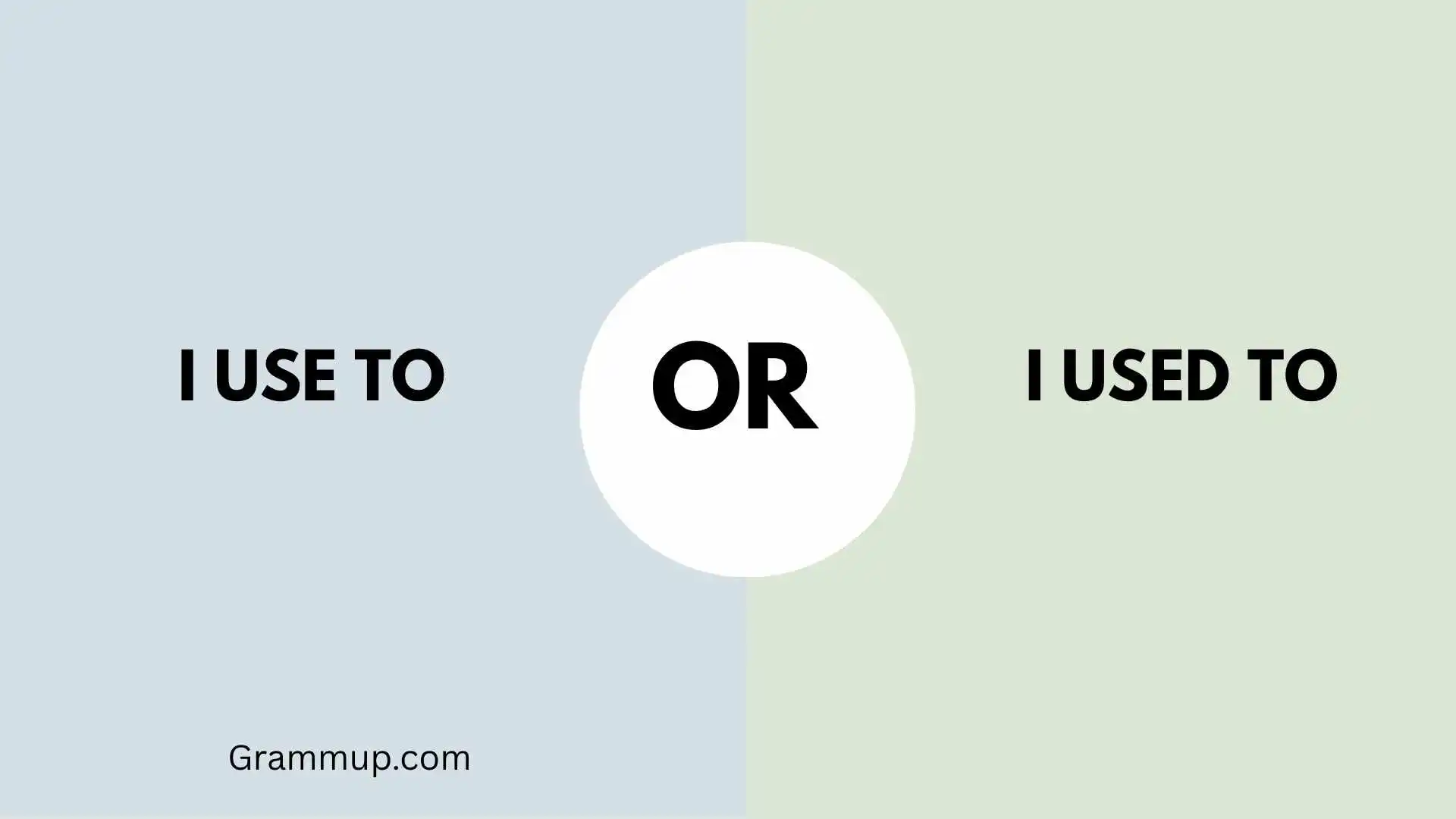
The phrases “I use to” and “I used to” may look very similar, but they have different grammatical uses. This small difference often confuses English learners, writers, and even native speakers when writing quickly.
Understanding when to use each phrase can help you make your English clearer, more natural, and grammatically correct.
“I used to” is commonly used to talk about a habit, action, or situation that happened regularly in the past but no longer happens now. For example, “I used to play football every day” means that playing football was a regular activity in the past, but it is not necessarily true today.
Quick Answer
The correct phrase for talking about past habits or states is “I used to.” The phrase “I use to” is incorrect in standard English. Always use “used to” when referring to actions or situations that happened regularly in the past but no longer happen.
Meaning and Definition of Each Phrase
I Used To
Definition:
“I used to” describes a past habit, state, or action that no longer happens. It shows something was true in the past but is not true now.
Example Sentences:
- I used to play football every weekend.
- She used to live in New York, but now she lives in Los Angeles.
- They used to go to the beach every summer.
Explanation:
This phrase is always followed by the base form of a verb (play, live, go, etc.). It emphasizes past routines or habits that have stopped.
I Use To
Definition:
Technically, “I use to” is incorrect when talking about past habits. People sometimes say it in spoken English because it sounds similar to “used to,” but it is not grammatically correct.
Incorrect Example Sentences:
- ❌ I use to play football every weekend.
- ❌ She use to live in New York.
Corrected Version:
- ✅ I used to play football every weekend.
- ✅ She used to live in New York.
Explanation:
The confusion often comes from the way “used to” sounds when spoken. In pronunciation, “used to” can sound like “use to,” leading many learners to write it incorrectly.
Key Differences Between “I Use To” and “I Used To”
- Tense:
- Used to: Refers to past habits or states (correct).
- Use to: Not used in standard English for past habits (incorrect).
- Used to: Refers to past habits or states (correct).
- Verb Form:
- Used to: Always followed by the base verb (I used to play).
- Use to: Incorrectly written but sometimes heard in speech.
- Used to: Always followed by the base verb (I used to play).
- Meaning:
- Used to: Describes actions or states that were true in the past but not now.
- Use to: Confusing and grammatically wrong.
- Used to: Describes actions or states that were true in the past but not now.
Comparison Table
| Phrase | Meaning | Usage | Example |
| I used to | Past habits or states no longer true | Correct in writing & speech | I used to travel a lot, but now I stay home. |
| I use to | Incorrect form | Avoid in writing | ❌ I use to travel a lot. ✅ I used to travel a lot. |
Examples in Sentences
Correct Usage of “I Used To”:
- I used to wake up early, but now I sleep late.
- He used to smoke, but he quit last year.
- We used to go camping every summer.
- She used to be very shy in school.
Incorrect Usage of “I Use To” (and correction):
- ❌ I use to love chocolate. → ✅ I used to love chocolate.
- ❌ They use to play in the park. → ✅ They used to play in the park.
- ❌ He use to visit his grandparents. → ✅ He used to visit his grandparents.
Common Mistakes
- Writing “I use to” instead of “I used to”
- Incorrect: I use to read every night.
- Correct: I used to read every night.
- Incorrect: I use to read every night.
- Confusing with present tense
- Incorrect: I used to like ice cream (if you still like it).
- Correct: I like ice cream (present tense).
- Incorrect: I used to like ice cream (if you still like it).
- Using “use to” in formal writing
- Avoid “I use to” in essays, emails, or articles. Always use “used to.”
- Avoid “I use to” in essays, emails, or articles. Always use “used to.”
Tips to Remember the Difference
- Think past: If you are talking about the past, always use used to.
- Listen carefully: In speech, “used to” may sound like “use to,” but writing always needs used to.
- Memory trick: “I used to do it → I did it in the past.”
When to Use Each Phrase
- I used to: Use it when describing past habits, repeated actions, or past situations.
- Example: I used to go jogging every morning.
- Example: I used to go jogging every morning.
- I use to: Avoid in standard English; it is only a misheard or informal version.
Grammar Rules
- Form: I + used to + base verb
- Example: I used to play, I used to eat, I used to live.
- Example: I used to play, I used to eat, I used to live.
- Negative:
- I did not use to + verb
- Example: I did not use to like coffee.
- I did not use to + verb
- Question form:
- Did + subject + use to + verb?
- Example: Did you use to play football?
- Did + subject + use to + verb?
Synonyms or Related Words
- Formerly – She formerly lived in London.
- Previously – He previously worked in a bank.
- In the past – In the past, I used to travel a lot.
Frequently Asked Questions (FAQs)
1. Can I say “I use to” in spoken English?
Yes, sometimes people say it when speaking, but it’s grammatically incorrect. Always write “I used to.”
2. How do I make negative sentences with “used to”?
Use did not use to + verb. Example: I did not use to eat vegetables.
3. Can I use “used to” for states as well as actions?
Yes, it can describe both actions (I used to swim) and states (I used to be shy).
4. Is “used to” the same as “usually”?
No, “used to” refers to past habits, while “usually” refers to current routines.
5. How do I form questions with “used to”?
Use Did + subject + use to + verb. Example: Did you use to live here?
6. Can “use to” ever be correct?
Only in negative or question forms with “did,” like: Did you use to play football?
Conclusion
The correct phrase to use when talking about past habits or states is “I used to.” Avoid using “I use to” in writing, as it is grammatically incorrect. Remember: if it’s about something that happened in the past but no longer happens, used to is always your choice. Keep practicing, and soon it will become second nature.