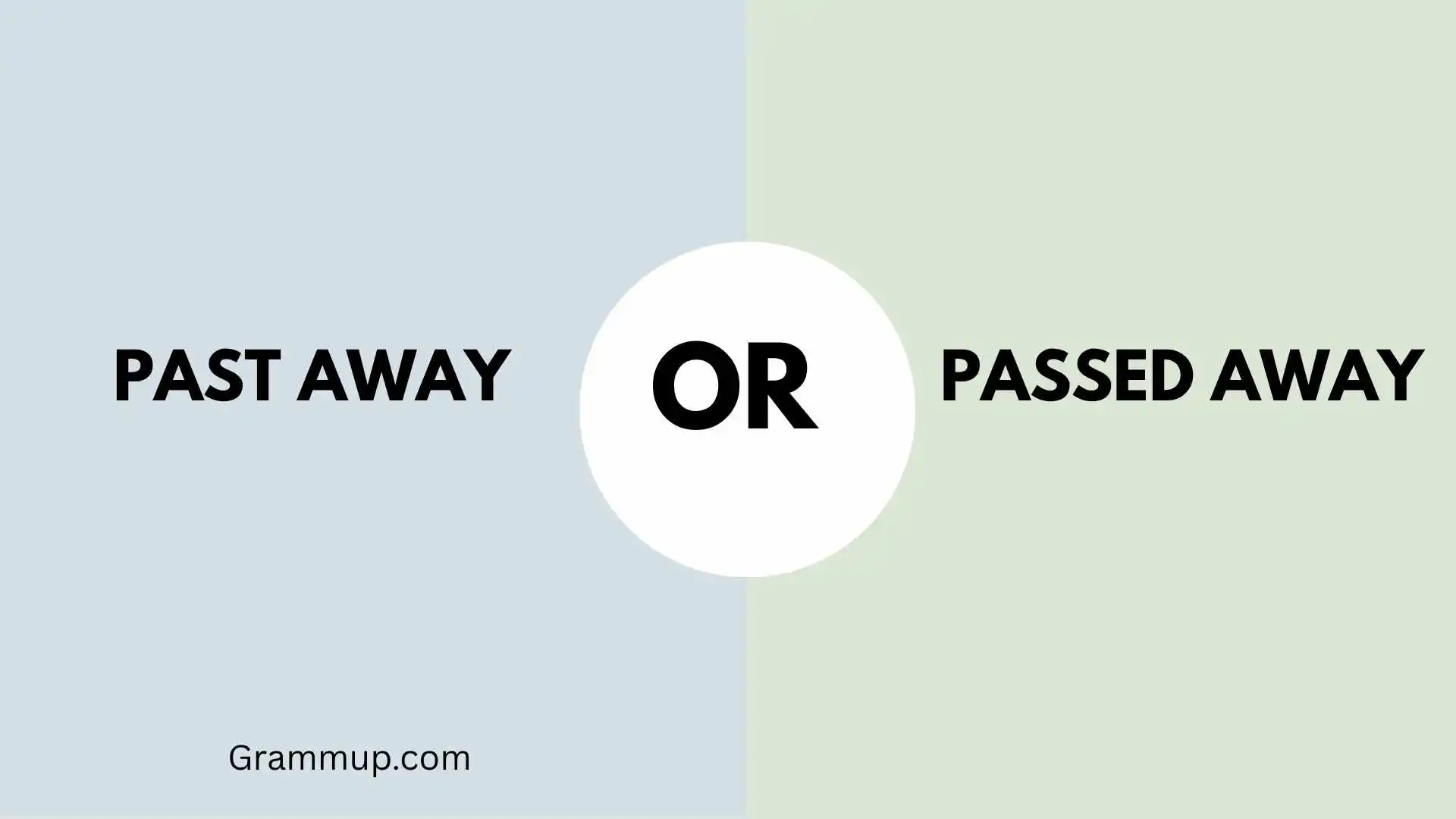
Losing someone we love is one of the hardest experiences in life, and finding the right words to talk about it can be difficult. One common confusion is “Past Away or Passed Away.”
Although these two phrases sound almost identical, only one is correct when referring to someone’s death. The correct expression is “passed away,” which is a gentle and respectful way to say that a person has died.
You may see or hear “past away” because the words are pronounced similarly, especially in fast conversations, but “past” does not work in this expression. Understanding the difference between past away and passed away can help you write and speak more accurately while also choosing respectful language when discussing sensitive situations.
Quick Answer
The correct phrase is “passed away.” It is a polite and respectful way to say that someone has died.
“Past away” is incorrect because “past” is usually used as a time or position word, not as a verb.
Meaning and Definition of Each Word
To understand the difference between past away or passed away, we first need to understand the meaning of each word separately.
Meaning of “Passed Away”
Passed away is a polite expression used to say that someone has died. It is a softer and more respectful way of saying “died.”
Simple Definition:
“Passed away” means someone is no longer alive.
Examples:
- My grandfather passed away last year.
- Her mother passed away peacefully in her sleep.
- Many people were sad when the famous actor passed away.
This phrase is very common in formal writing, sympathy messages, news articles, and respectful conversations.
Meaning of “Past Away”
Past away is not correct in normal English usage. The word “past” is not a verb. It is usually used as:
- A noun (the past = time before now)
- A preposition (walk past the shop)
- An adjective (past experience)
Because “past” is not a verb, the phrase past away does not make grammatical sense.
Incorrect Examples:
- My uncle past away yesterday. ❌
- She past away in 2020. ❌
The correct version should always be passed away.
Key Differences Between the Words
Here are the main differences between past away or passed away:
- Passed away is correct and commonly used.
- Past away is incorrect and should not be used.
- “Passed” is the past tense of the verb pass.
- “Past” is usually used as a noun, adjective, or preposition.
- “Passed away” is a respectful way to talk about death.
- “Past away” is simply a spelling mistake.
Comparison Table
| Word | Meaning | Usage | Example Sentence |
| Passed away | A polite way to say someone died | Correct and commonly used | My neighbor passed away yesterday. |
| Past away | No real meaning in English | Incorrect usage | My neighbor past away yesterday. ❌ |
Examples in Sentences
Let’s look at more real-life examples so you can clearly understand how to use passed away correctly.
Correct Sentences
- My grandmother passed away at the age of 90.
- The teacher passed away after a long illness.
- His father passed away two years ago.
- The famous singer passed away suddenly.
- Our pet dog passed away last night.
- Many people attended the funeral after she passed away.
- He was very young when his mother passed away.
- The news said that the actor passed away peacefully.
Incorrect Sentences
- My grandmother past away at the age of 90. ❌
- The teacher past away after a long illness. ❌
- His father past away two years ago. ❌
Always remember: passed away = correct, past away = incorrect.
Common Mistakes
Many learners make mistakes because the words past and passed sound the same. This causes confusion when writing.
Here are the most common mistakes:
Mistake 1: Using “past” instead of “passed”
Incorrect:
My uncle past away last year.
Correct:
My uncle passed away last year.
Mistake 2: Thinking both are correct
Some people think both phrases can be used, but this is not true.
Incorrect idea: Past away and passed away mean the same thing. ❌
Correct idea: Only passed away is correct. ✔️
Mistake 3: Using “past away” in formal writing
This mistake often appears in sympathy messages, emails, and social media posts.
Incorrect:
We are sorry to hear that your father past away.
Correct:
We are sorry to hear that your father passed away.
Tips to Remember the Difference
Here are some simple memory tricks to help you remember the correct usage of past away or passed away.
Tip 1: Remember the word “pass”
The correct phrase comes from the verb pass.
- pass → passed → passed away
If you remember the verb “pass,” you will never write “past away.”
Tip 2: Think about action words
“Passed” is an action word (a verb).
“Past” is not an action word.
Since dying is an action, the correct word must be passed.
Tip 3: Use this simple sentence trick
Say this in your mind:
“He passed away yesterday.”
It sounds correct and natural.
“He past away yesterday” sounds strange.
When to Use Each Word
Let’s understand when to use passed and past in different situations.
When to Use “Passed Away”
Use passed away when talking about someone’s death in a respectful way.
Examples:
- In sympathy messages
- In formal writing
- In news articles
- In respectful conversations
- When talking about family members
Example:
- My grandfather passed away peacefully.
When to Use “Past”
Use past when talking about time, position, or something that already happened.
Examples:
- The past is full of memories.
- She walked past the house.
- This problem is now in the past.
Grammar Rules (If Applicable)
To fully understand past away or passed away, you need to know a simple grammar rule.
Rule 1: “Passed” is a verb
“Passed” is the past tense of the verb pass.
Examples:
- He passed the exam.
- She passed the ball.
- The time passed quickly.
- My uncle passed away last year.
Rule 2: “Past” is not a verb
“Past” is usually used as:
- A noun (the past)
- An adjective (past experience)
- A preposition (walk past the shop)
Examples:
- Forget the past.
- That is a past mistake.
- He ran past the building.
Because “past” is not a verb, it cannot be used in the phrase past away.
Synonyms or Related Words
Here are some polite and respectful alternatives to passed away:
- Died
- No longer with us
- Left this world
- Departed
- Passed on
- Lost his life
- Rest in peace
- Went to heaven
Examples:
- My uncle passed on last year.
- Her grandfather is no longer with us.
- The actor departed peacefully.
These expressions are often used in formal and respectful situations.
Frequently Asked Questions (FAQs)
1. Is it past away or passed away?
The correct phrase is passed away. “Past away” is incorrect.
2. Why do people write past away instead of passed away?
People make this mistake because both words sound the same when spoken. However, only “passed away” is grammatically correct.
3. Is passed away formal or informal?
“Passed away” is a polite and respectful expression. It is commonly used in both formal and informal situations.
4. Can I use past away in writing?
No, you should never use “past away.” It is considered incorrect English.
5. What does passed away mean?
“Passed away” means someone has died. It is a softer and more respectful way to say “died.”
6. Which one should I use in sympathy messages?
You should always use passed away in sympathy messages because it sounds polite and respectful.
Example:
- I am very sorry to hear that your father passed away.
Conclusion
In conclusion, “Passed Away” is the correct phrase when referring to someone’s death. It is a polite and respectful expression commonly used in formal and everyday English. “Past Away” is incorrect because “past” refers to something that has already happened or a time before now, while “passed” is the past tense of “pass.” Remembering this simple difference can help you avoid a common spelling mistake. Whether you are writing a sympathy message, discussing a loss, or using the phrase in an article, always choose “Passed Away.” Using the correct form makes your English clearer, more accurate, and respectful.