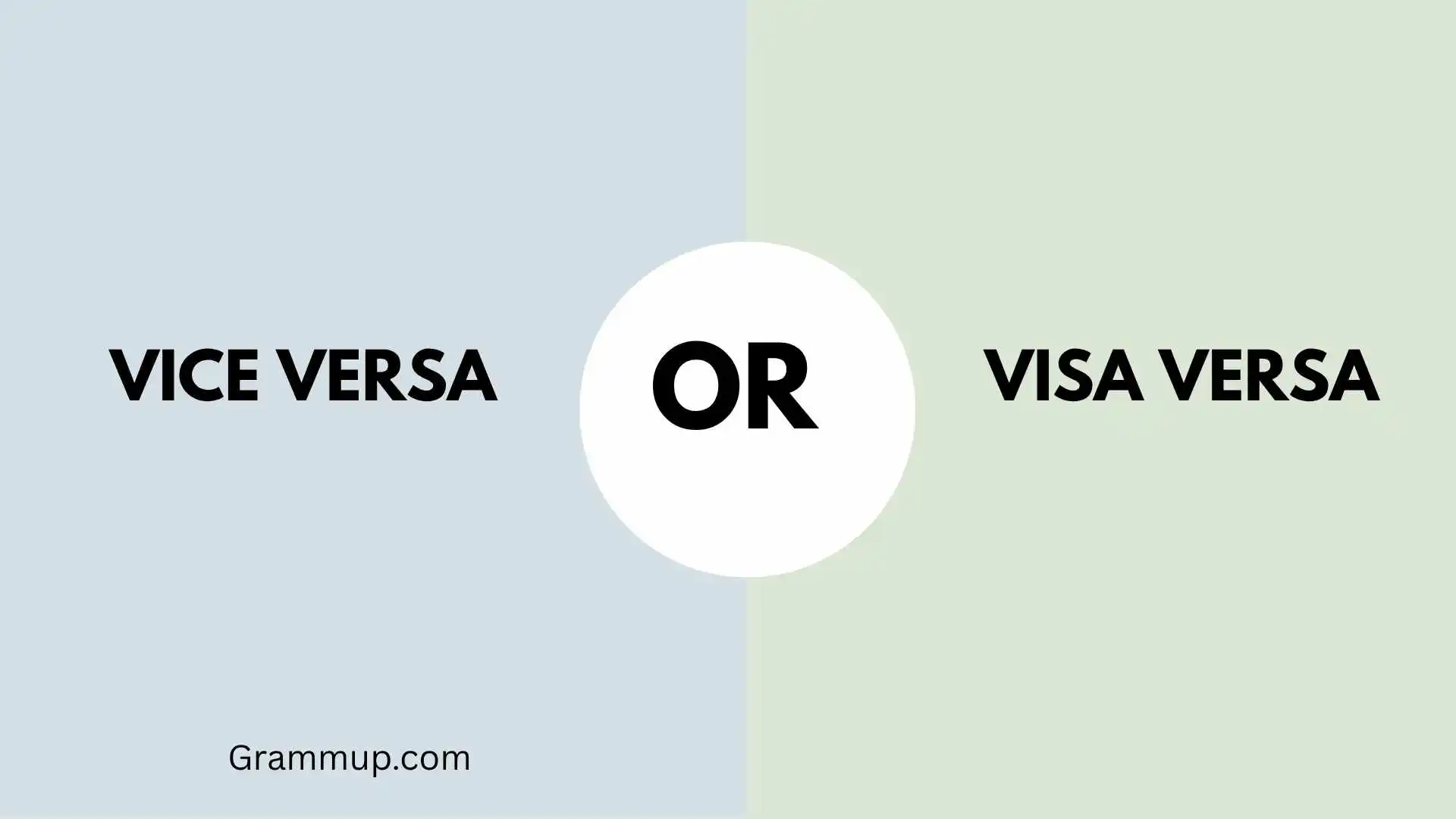
Vice Versa or Visa Versa? is a common spelling question that often confuses English learners and writers. Many people hear the phrase in conversations and mistakenly write “Visa Versa,” but the correct spelling is “Vice Versa.”
This popular Latin phrase is widely used in everyday English to show that the opposite of a statement is also true. For example, if you say, “I help my friend, and vice versa,” it means your friend helps you too.
Understanding the difference between Vice Versa and Visa Versa can improve your writing and prevent a common spelling mistake. Since the phrase is frequently used in emails, conversations, school assignments, and professional writing, knowing the correct form is helpful. Vice versa has a simple meaning, but its spelling can be tricky because many people pronounce it quickly and hear it incorrectly.
Quick Answer
“Vice versa” is the correct phrase. It means “the other way around” or “with the order reversed”. The term “visa versa” is a common misspelling and should be avoided.
Meaning and Definition of Each Word
1. Vice Versa
Definition:
“Vice versa” is a Latin phrase that means “the other way around” or “reversing the order of things”.
Explanation:
Whenever you want to indicate that a statement works in both directions, use vice versa.
Example Sentences:
- I like her, and vice versa she likes me too.
- Teachers should respect students, and vice versa.
- The software can run on Mac and Windows, and vice versa.
2. Visa Versa
Definition:
Visa versa is a common misspelling of vice versa. It has no meaning in English and should not be used in formal or informal writing.
Example Sentences (Incorrect):
- I like him, and visa versa. ❌
- The rules apply to students and visa versa. ❌
Key Differences Between the Words
- Correctness:
- Vice versa → Correct and widely accepted
- Visa versa → Incorrect
- Vice versa → Correct and widely accepted
- Meaning:
- Vice versa → “the other way around”
- Visa versa → No meaning
- Vice versa → “the other way around”
- Origin:
- Vice versa → Latin phrase
- Visa versa → Incorrect spelling
- Vice versa → Latin phrase
- Usage:
- Vice versa → Can be used in both spoken and written English
- Visa versa → Should never be used
- Vice versa → Can be used in both spoken and written English
Comparison Table
| Word | Meaning | Usage | Example Sentence |
| Vice versa | The other way around | Correct phrase | I respect him, and vice versa. |
| Visa versa | No meaning (incorrect) | Avoid using | ❌ I respect him, and visa versa. |
Examples in Sentences
Using Vice Versa Correctly
- She can help him, and vice versa.
- Dogs love their owners, and vice versa.
- The teacher learned from students, and vice versa.
Using Visa Versa Incorrectly
- I will call you, and visa versa. ❌
- We trust each other, and visa versa. ❌
Common Mistakes
- Incorrect: I love reading your blog, and visa versa. ❌
Correct: I love reading your blog, and vice versa. ✅ - Incorrect: Students should listen to teachers, and visa versa. ❌
Correct: Students should listen to teachers, and vice versa. ✅ - Incorrect: I help you, and visa versa. ❌
Correct: I help you, and vice versa. ✅
Tips to Remember the Difference
- Think “vice” = “in place of” in Latin. So vice versa = “the other way around.”
- Remember: “visa” is for travel documents, not for reversing orders.
- If in doubt, always spell it as vice versa.
When to Use Each Word
- Vice versa is used:
- To show mutual relationships: “He likes her, and vice versa.”
- To indicate reversed situations: “The app works on Mac and Windows, and vice versa.”
- To show mutual relationships: “He likes her, and vice versa.”
- Visa versa should never be used.
Grammar Rules (if applicable)
- Vice versa is invariable; it does not change form.
- It is used after a statement or phrase:
- Correct: “She respects him, and vice versa.”
- Incorrect: “She respects him, and vices versa.”
- Correct: “She respects him, and vice versa.”
Synonyms or Related Words
- The other way around
- Mutually
- Reversely
Example: “She trusts him, and the feeling is mutual.”
Frequently Asked Questions (FAQs)
Q1: Is visa versa correct?
A: No, visa versa is incorrect. Always use vice versa.
Q2: What does vice versa mean?
A: It means “the other way around” or “reversing the order”.
Q3: Can vice versa be used in formal writing?
A: Yes, it is acceptable in both formal and informal writing.
Q4: Is vice versa one word or two words?
A: It is two words: vice versa.
Q5: Can I use vice versa at the beginning of a sentence?
A: Yes, but it is more common at the end. Example: “I like him, and vice versa.”
Q6: Are there other Latin phrases like vice versa in English?
A: Yes, examples include et cetera (etc.), ad hoc, per se, and status quo.
Conclusion
To sum up, the correct phrase is vice versa, which means “the other way around”. Visa versa is a misspelling and should be avoided. Remembering this simple difference will help you write and speak English confidently. Keep practicing using vice versa in sentences, and soon it will become second nature.